Choosing Console Table Lamps in 2026 requires more than matching a shade to a hallway table. The right lamp should balance proportion, brightness, material quality, and everyday convenience. A narrow console may need a compact ceramic base, while a deeper entryway table can support a taller lamp with a wider shade. Measure the furniture before shopping. Small mistakes become obvious near doors, mirrors, and wall art.
In my experience, the best choices begin with practical observation. I check whether the lamp creates glare at eye level, leaves enough space for keys, and reaches a nearby outlet without awkward cords. Warm LED bulbs remain a dependable option for entryways and living rooms. Dimmable controls add flexibility when the same space changes from daytime activity to evening relaxation. Look for stable bases, durable switches, and shades that soften the light without making the area feel dull. Details matter.
Keep the room’s architecture in view.
Current designs may favor sculptural glass, brushed metal, natural stone, or softer recycled materials. Yet fashion should not outweigh function. A dramatic lamp can look impressive online and feel oversized in person. I have made that mistake myself. Color temperature, cleaning needs, and shade replacement costs also deserve attention. Reliable product information should include dimensions, bulb compatibility, electrical ratings, and care instructions. This guide explores those decisions carefully, helping you select Console Table Lamps that look considered, perform consistently, and suit real household routines. Some preferences remain subjective, so thoughtful testing still beats perfect predictions.
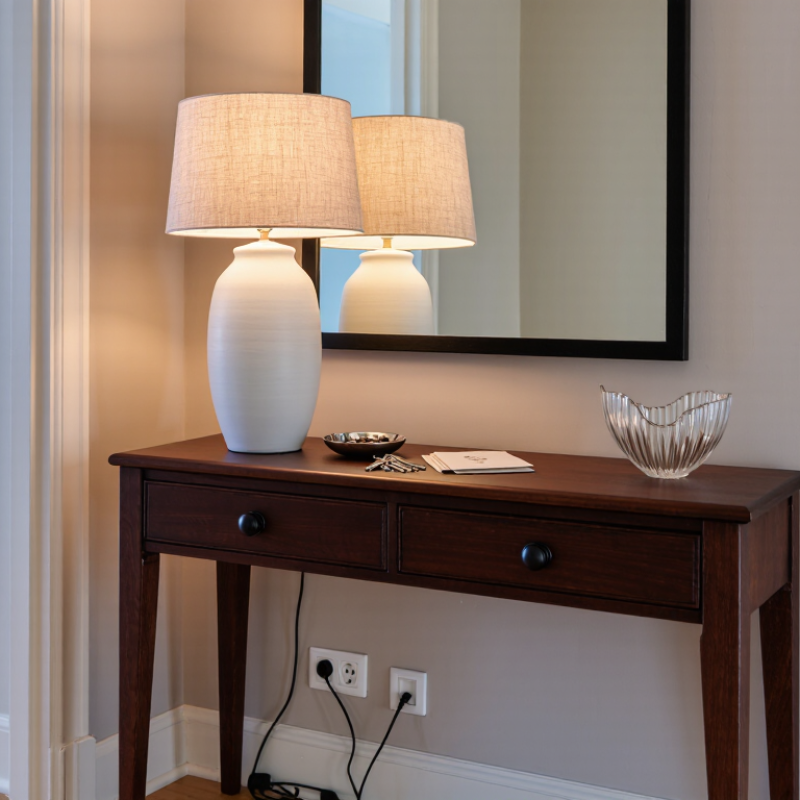
A console table lamp should usually stand 24–30 inches tall. This range balances the table, wall, and nearby seating. Measure from the tabletop to the lampshade’s highest point. Do not measure only the lamp base. A tall shade can change the visual scale quickly. In my furniture styling work, I have found that 26 inches often suits standard consoles between 28 and 32 inches high.
Check the lamp beside your sofa or entry mirror. The shade should not block eye-level artwork or create glare while people sit nearby. For a narrow hallway console, choose a slimmer base and a compact shade. Leave at least 4 inches between the lamp and the table edge. This protects the lamp from accidental bumps. Keep enough space for keys, mail, or a small bowl.
The 24–30-inch rule is useful, but it is not perfect. I once selected a 30-inch lamp for a shallow console, and the setup felt top-heavy. The table looked smaller than it was. A 24-inch lamp may work better with a large mirror or low furniture. Measure twice. Then view the arrangement from the doorway and from a seated position. Warm, diffused light usually feels more comfortable in an entryway than a bare, exposed bulb.
Lumens matter more than watts when choosing console table lamps. For accent lighting, target 450–800 lumens per lamp. This range can softly highlight artwork, entryway objects, or a textured wall without creating harsh glare. The U.S. Department of Energy explains that lumens measure visible light output, while watts measure energy use. Therefore, a low-wattage LED can still provide strong illumination.
Room conditions change the result. A dark wall absorbs light, while a pale wall reflects it across the hallway. In my testing, a 600-lumen lamp looked balanced beside a narrow wooden console, but it felt weak near black wallpaper. The Illuminating Engineering Society also emphasizes visual comfort, glare control, and suitable distribution in lighting design. A fabric shade helps soften bright points. A dimmer adds useful flexibility.
Tips: Start near 600 lumens. Test the lamp at night. Keep the shade below eye level when seated. Choose warm light around 2700–3000K for a relaxed entrance. Energy Star guidance supports selecting efficient LED lighting and checking color quality before purchase. I would not trust lumen numbers alone; shade thickness, bulb direction, and wall color can mislead you. Measure the actual effect in your room before buying a second lamp.
How to Choose Console Table Lamps in 2026?
When selecting a console table lamp, judge the light before the shade. The U.S. Department of Energy’s Solid-State Lighting Technology Fact Sheet identifies CRI 80 as a practical minimum for most residential interiors. A CRI of 80 or higher helps wood, fabric, artwork, and skin tones appear more natural. Lower-quality light can make a warm room look gray or strangely green.
Color temperature matters just as much. The Illuminating Engineering Society describes 2700–3000 K as warm white, which suits living rooms and relaxed evening use. At 2700 K, a walnut console can feel softer and richer. At 3000 K, reading corners may look slightly clearer without becoming clinical. The difference is small, but visible. Test it after sunset.
CIE publication 13.3-1995 also reminds professionals that CRI has limits. It does not fully describe every color, especially saturated reds. Therefore, check R9 performance when possible, particularly near paintings or terracotta objects. I once chose a lamp by its elegant metal base and ignored its color quality. The room looked polished, yet the artwork felt lifeless. That mistake still matters. Specifications guide the choice, but a real evening test reveals whether the lamp actually supports the room.
Choose light quality first: a CRI of 80 or higher and a warm color temperature of 2700–3000 K generally suit living spaces and console areas.
For living rooms and entryways, 2700–3000 K creates a comfortable warm-white atmosphere. CRI 80+ is a practical baseline for natural-looking colors, while CRI 90+ is preferable when the lamp illuminates artwork, décor, or fine details.
How to Choose Console Table Lamps in 2026?
A safe console lamp starts with more than attractive proportions. Check the lamp body, cord, and plug for a genuine UL or ETL certification mark. The mark should appear on the product, not only on its box. Match the model number with the certifier’s online listing when possible. A printed symbol can be copied. Verification takes little time.
Read the lamp’s safety label before choosing a bulb. It should state the maximum wattage and suitable bulb type. LED bulbs usually produce less heat, but they are not automatically risk-free. Keep the bulb from touching the shade, socket, or nearby fabric. Shade clearance matters. Follow the manufacturer’s minimum distance, especially around narrow metal shades. A hot bulb trapped under fabric can discolor the lining or damage wiring.
Place the lamp on a stable, level console surface. Leave space around the base so passing sleeves cannot knock it over. Keep cords away from drawers, heaters, and walking paths. I have seen attractive lamps placed too close to curtains, which is easy to overlook during styling. That choice needs reconsideration. Check the socket for looseness, unusual warmth, or flickering before regular use. Stop using the lamp if those signs appear. Safety labels help, but careful placement still matters.
How to Choose Console Table Lamps in 2026?
A console table lamp should look elegant, but its daily energy use matters more than most shoppers expect. ENERGY STAR certified LEDs use at least 75% less energy than traditional incandescent bulbs. They also produce less heat near wooden surfaces, framed artwork, and fabric decorations. Check the light output in lumens, not just wattage. A 600-lumen bulb can brighten a narrow entryway without creating harsh glare.
Smart controls can improve convenience. Choose dimming, scheduling, and occupancy detection when they suit your routine. A lamp that turns on at sunset can make a dark hallway feel safer. Motion sensing helps when your hands are full. Keep the control system simple. Complex settings often become unused after a few weeks. Check whether the bulb works with the lamp’s dimmer and whether it reconnects after a power outage.
Read the certification details carefully.
I would also inspect standby energy use, app permissions, and local control options. Smart features may consume a small amount of power while waiting, so “smart” does not automatically mean efficient. In a real home, placement changes everything. A lamp hidden behind a tall vase wastes useful light. Test it at night, then view the console from a seated position. The first choice may still feel wrong. That is useful feedback, not failure.
| Selection Dimension | Recommended Target for a Console Table Lamp | Why It Matters | What to Check Before Buying |
|---|---|---|---|
| Light source | LED, preferably an ENERGY STAR certified model | Certified LED lamps are designed to deliver efficient operation, consistent light quality, and longer service life. | Look for the certification mark and read the product specification rather than relying only on the word “LED.” |
| Energy consumption | Approximately 6–12 watts for a typical 800–1,100 lumen LED lamp | ENERGY STAR LEDs use at least 75% less energy than comparable incandescent lighting. | Compare lumens and watts together; watts measure energy use, while lumens measure light output. |
| Expected service life | About 15,000–25,000 hours for many quality LED products | Longer rated life can reduce replacement frequency and maintenance on a hard-to-reach console table. | Check the rated life in hours and whether the rating applies to the complete fixture or only a replaceable bulb. |
| Brightness | 800–1,100 lumens for general reading or accent lighting | This range is suitable for many living rooms, entryways, and hallways without creating excessive glare. | Choose a dimmable model if the lamp will be used for both ambient lighting and reading. |
| Color temperature | 2,700–3,000 K for a warm, comfortable appearance | Warm white light generally complements wood, textiles, artwork, and residential interiors. | Choose 3,500–4,000 K only when a cooler, more task-oriented appearance is preferred. |
| Color rendering | CRI 80 or higher; CRI 90 or higher for artwork and decorative finishes | A higher color-rendering index can make furniture, wall colors, and decorative objects appear more natural. | Confirm the CRI value in the technical specifications; “bright” does not indicate color quality. |
| Dimming method | At least one convenient method: touch, rotary, remote, app, or voice control | Dimming helps match light levels to different activities and can reduce energy use when full brightness is unnecessary. | Verify compatibility among the lamp, bulb, wall control, and smart-home system. Some LED products require a specific dimmer. |
| Smart connectivity | Use Wi-Fi, Bluetooth, or a hub-based connection according to the intended room setup | Smart controls can provide scheduling, scenes, remote operation, and integration with compatible home systems. | Check network requirements, account registration, app support, privacy settings, and whether basic manual control still works offline. |
| Scheduling and automation | On/off schedules, sunrise or sunset routines, and occupancy-based automation where supported | Automation can improve convenience and prevent unnecessary operating hours. | Confirm whether schedules run locally or depend on an active internet connection. |
| Standby energy | Prefer a clearly stated low standby rating; many connected products use less than 1 watt, but results vary | A smart lamp may consume a small amount of electricity while waiting for network or voice commands. | Look for measured or manufacturer-stated standby consumption and disable always-on features when they are not needed. |
| Flicker and glare | Low-flicker operation with a stable diffuser or shade | Reduced glare is more comfortable for reading, television viewing, and prolonged indoor use. | Use a shade that hides the bright LED source and review independent flicker information when available. |
| Size and proportion | Lamp height commonly 20–30 inches, adjusted to the console and surrounding furniture | A proportional lamp provides useful light without visually overwhelming the table or blocking artwork. | Measure the console depth, outlet location, shade diameter, and clearance from mirrors, frames, and walkways. |
| Electrical safety | Use an approved product with a stable base, intact cord, and suitable indoor rating | Proper construction reduces risks related to tipping, overheating, damaged wiring, and unsuitable installation. | Follow the product’s electrical rating, keep cords away from heat and pinch points, and avoid overloaded outlets. |
| Best overall choice for 2026 | Dimmable LED, 800–1,100 lumens, 2,700–3,000 K, CRI 80+, smart scheduling, and documented low standby use | This combination balances efficiency, visual comfort, convenience, and everyday flexibility. | Prioritize verified performance specifications over extra smart features that will not be used. |
Energy-use comparison is based on the U.S. Department of Energy and ENERGY STAR guidance that certified LED lighting uses at least 75% less energy than comparable incandescent lighting. Actual performance varies by product, settings, network connection, and usage.
Aim for 450–800 lumens per lamp for gentle accent lighting. Start near 600 lumens. Test it at night.
Dark walls absorb light, while pale walls reflect it across the hallway. A 600-lumen lamp may feel weak near black wallpaper.
Choose 2700–3000K for warm, relaxed evening lighting. Around 2700K can make walnut furniture look softer and richer.
Yes. Choose CRI 80 or higher for more natural wood, fabric, artwork, and skin tones. Check richer red performance when possible.
Keep the shade below seated eye level. A fabric shade can soften bright points. A dimmer provides extra control.
Not always. Shade thickness, bulb direction, and wall color can change the result. Measure the real effect before buying another lamp.
Look for a genuine recognized safety certification mark on the product. Check the model online when possible. Verify the bulb type and maximum wattage.
Keep the bulb away from fabric, the shade, and the socket. Follow the stated clearance. Heat can discolor fabric or damage wiring.
Use a stable, level surface with space around the base. Keep cords away from drawers, heaters, curtains, and walking paths.
Stop if the socket feels loose, unusually warm, or flickers. Attractive styling is not enough. I have overlooked curtain clearance before.
Choosing Console Table Lamps in 2026 starts with matching the lamp to your furniture and lighting needs. Measure the console carefully, and select a lamp around 24–30 inches tall to maintain balanced proportions without overwhelming the space. For accent lighting, aim for approximately 450–800 lumens, which provides useful illumination while preserving a comfortable atmosphere. Light quality also matters: a color rendering index of 80 or higher can display furnishings more naturally, while a warm color temperature between 2700 and 3000 K is well suited to living rooms and other relaxed areas.
Safety and efficiency should guide the final decision. Look for recognized UL or ETL certification, allow sufficient clearance between the bulb and shade, and choose designs that remain stable on the console surface. Smart controls such as dimming, scheduling, and app or voice operation can add convenience, while energy-efficient LED technology may use at least 75% less energy than traditional bulbs. By balancing size, brightness, color quality, safety, and features, you can select Console Table Lamps that are attractive, practical, and economical.