New
Reading
Projects
Talk To A Specialist +1 717 737 7120
0%

Hotel bathroom lighting must do more than make a mirror look polished. In 2026, guests expect clear light for shaving, makeup, and evening routines. Hotel teams also need fixtures that hold up to frequent use and cleaning. This guide explores how to choose Hotel Bathroom Vanity Lights that balance useful facial illumination, visual comfort, and a coherent design.

A bright bulb alone is not the answer. Placement matters. Lights mounted beside a mirror can soften facial shadows, while overhead lighting helps the room feel complete. Compare color rendering, color temperature, lumen output, dimming compatibility, finish durability, and suitability for damp locations. Check the manufacturer’s documentation and installation requirements; a qualified professional can assess what suits the project. Consider upkeep, too. A narrow glass shade may look elegant but collect water spots that housekeeping must remove often. That trade-off can be easy to miss in a showroom. Mirror width, ceiling height, room size, and nearby finishes all affect scale and placement. No single specification works for every property. The guidance ahead offers a practical framework, not a universal formula, since guest expectations and building conditions vary. Use it to compare fixtures before approving samples or repeating a specification across multiple rooms.
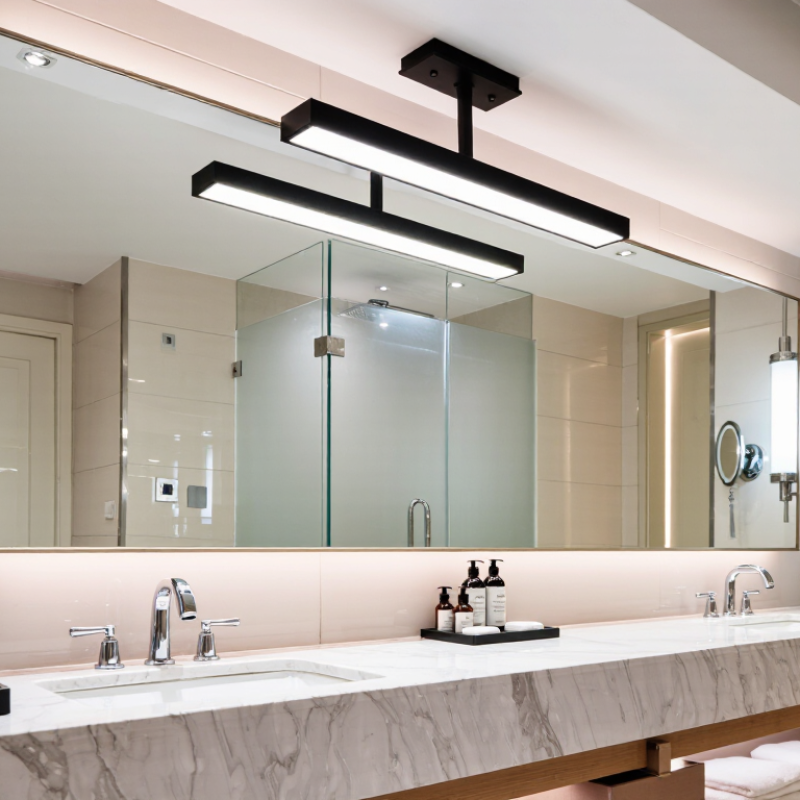
2026 How to Choose Hotel Bathroom Vanity Lights?

Define Hotel Bathroom Vanity Lighting Needs and Usage Conditions

Hotel bathroom vanity lighting should be planned around the room and the guest’s routine. A narrow vanity in a city hotel may need a different layout from a wide double sink in a resort suite. Note the mirror width, ceiling height, shower location, and distance between the sink and wall. These details affect where light can go and how easily staff can clean around it.

Guests use the mirror for shaving, makeup, and quick checks before leaving. Light from both sides of the mirror can reduce harsh facial shadows, while a fixture placed directly overhead may create dark areas around the eyes. Check the view from standing and seated positions. Glare matters. A bright bulb reflected in the mirror can feel uncomfortable, even when the room seems well lit. Choose lighting with a suitable color appearance for the property, and review samples in the actual bathroom; wall finishes can shift how light looks.

Moisture and maintenance also shape the choice. Use fixtures rated for their installation location, and confirm electrical requirements with a qualified professional. Consider how staff will wipe the lens and reach the fixture. A complicated design may look refined on paper but collect dust or slow room turnover. A floor-plan sketch helps, though it can miss reflections from glossy tile. Test a mock-up when possible, then adjust the position before ordering for every room.

Compare Fixture Types, Brightness, and Color Quality

For hotel bathrooms, compare vertical bars beside the mirror with a horizontal fixture above it. Side-mounted lights can reduce shadows under the eyes and chin; an overhead-only fitting often leaves faces unevenly lit. Choose enclosed, diffused shades for a softer glow, especially around polished stone and glass. Still, glare is easy to underestimate.

Specify brightness in lumens, not watts, and assess the light at face level. A dimmer helps housekeeping and guests shift from close grooming to a softer evening setting. The U.S. Department of Energy’s LED guidance reports that LEDs use up to 90% less energy and can last up to 25 times longer than incandescent bulbs. That makes efficient sources practical for long operating hours, but poor placement can still spoil the mirror.

Color quality matters when guests check makeup, skin tone, or shaving details. WELL v2’s Electric Light Quality feature uses a color rendering index (CRI) of 90 or higher as a color-fidelity benchmark; consider this level for vanity lighting. Check the red-rendering value, R9, too, since standard CRI alone can miss weak reds. A warm 2700 K lamp may feel welcoming, while 3000 K often keeps whites clearer. Test samples against the actual tile and mirror. Small differences show. A slightly imperfect choice is common: finishes and daylight can change how a lamp looks after installation.

Match Light Placement and Fixture Size to Mirrors and Vanities

In a hotel bathroom, vanity lighting should make faces easy to see without washing out the mirror. Side sconces usually create more even light than a single overhead fixture. They can soften shadows under the eyes and chin. Place their centers near eye level, often about 60 to 66 inches above the floor. Adjust this height to suit the mirror and expected guests. Keep fixtures clear of medicine-cabinet doors and taps. A quick mock-up helps: tape the fixture outline beside the mirror and check it from the doorway.

Choose fixture size in relation to both the mirror and vanity. For one overhead bar, a useful starting point is about two-thirds to three-quarters of the mirror’s width. With paired sconces, place them near the mirror’s outer thirds rather than crowding its frame. A wide vanity with a narrow mirror may still feel unbalanced. It happens. Diffused shades can limit glare on glossy tile, while dimming lets guests adjust the room for different needs. Check the fixture’s location and water exposure before choosing its rating, and follow applicable local requirements. Test the light at night, too; a small shadow beside the basin can be surprisingly noticeable.

2026 How to Choose Hotel Bathroom Vanity Lights? — Match Light Placement and Fixture Size to Mirrors and Vanities
Design Dimension Practical Guideline Example or Check
Single mirror with one light above Choose a fixture approximately 75% to 100% of the mirror width. Keep it centered over the mirror and generally no wider than the mirror. For a 36 in (91 cm) mirror, consider a fixture about 27–36 in (69–91 cm) wide.
Fixture above a wide mirror Size the light to the mirror and sink area it serves, rather than automatically matching the full vanity width. Avoid a fixture that visually overwhelms the mirror. For a 48 in (122 cm) mirror over one sink, a 36–48 in (91–122 cm) fixture may fit; check the fixture’s proportions and available wall space.
Two sinks with one shared mirror Use a long, evenly diffused fixture centered over both sinks, or use separate mirror-and-light groupings for each sink. Align the light’s overall span with the shared mirror; check that illumination reaches both basin areas without dark gaps.
Two sinks with separate mirrors Center one appropriately sized fixture over each mirror, or place sconces on the sides of each mirror where wall space allows. Keep the two lighting arrangements visually balanced and align each one with its mirror and sink centerline.
Side-mounted sconces Place sconces on both sides of the mirror when possible, with the light source near face height. This can reduce shadows compared with relying only on an overhead fixture. A common starting point is about 60–66 in (152–168 cm) from the finished floor to the center of the light source; adjust for guest height, mirror size, and fixture design.
Spacing for side sconces Position each sconce close enough to light the face evenly while leaving clearance from the mirror edge and nearby cabinets. About 28–36 in (71–91 cm) between sconce centers is a useful starting range; confirm the actual fixture width and mirror layout.
Light above the mirror: mounting height Mount the fixture above the mirror with enough clearance for the mirror frame and the fixture’s canopy. Keep the light centered and avoid placing it so high that it creates strong downward shadows. Many installations place the fixture center roughly 75–80 in (191–203 cm) above the floor, but mirror height, ceiling height, and fixture shape should determine the final position.
Relationship to vanity width Keep the light visually proportional to both the mirror and vanity. A fixture may be narrower than the vanity, but it should still serve the sink or sinks evenly. Check the fixture against the mirror width first, then confirm it looks balanced within the vanity’s overall width.
Light color For a welcoming hotel bathroom, consider a consistent warm-to-neutral white light, commonly around 2700–3000 K. Use the same color temperature across vanity lights and other bathroom lights where practical to avoid visibly mismatched tones.
Color rendering Choose lamps or integrated LEDs with a high color rendering index for a more natural appearance of skin tones and finishes. CRI 90 or higher is a useful specification to look for when accurate color appearance is important.
Brightness and dimming Select output for the mirror area, room size, surface finishes, and guest needs. Dimming can support both grooming and a softer evening setting. Check the manufacturer’s lumen rating and confirm that the dimmer is compatible with the lamp or LED driver.
Moisture and electrical requirements Choose a fixture rated for its actual bathroom location and follow local electrical codes. Requirements can differ by location and installation zone. Verify the fixture’s damp- or wet-location rating, required clearances, and installation instructions before purchase.
Final fit check Measure the mirror, vanity, wall clearance, ceiling height, and nearby cabinet doors before selecting a fixture. Confirm that the fixture does not obstruct mirror use, interfere with doors or storage, or extend beyond the intended wall area.

Dimensions are practical starting points, not universal code requirements. Verify fixture specifications, site conditions, and applicable local codes before installation.

Check Safety Ratings, Durability, and Maintenance Requirements

In a hotel bathroom, vanity lights sit close to sinks, wet hands, and daily cleaning. Check the fixture’s safety label and installation instructions before comparing its appearance. Choose a recognized electrical safety listing and a damp- or wet-location rating suited to placement and local requirements. Do not assume a sealed-looking shade is protected. Moisture finds gaps.

Durability shows up in small details. Look for corrosion-resistant finishes, secure glass or diffusers, and components designed for frequent switching. Ask whether the LED driver or other service parts can be replaced without removing the whole fixture. In coastal properties or rooms cleaned several times daily, test samples under the actual cleaning routine. A finish can look tough in a showroom and still dull after repeated wiping.

Maintenance should be simple for staff working between guest checkouts. Smooth surfaces and accessible fasteners reduce dust traps and repair time. Confirm that cleaners will not damage coatings, and keep spare service parts consistent with the installed fixture. Record inspection dates and recurring failures. Keep it practical. Hotel teams can overvalue low purchase cost; labor, downtime, and repair access may matter more. I would still inspect a sample after a few weeks, because specifications do not reveal every real-world weakness.

Choose Controls and Confirm Installation Requirements for 2026

2026 How to Choose Hotel Bathroom Vanity Lights?

Choose Controls and Confirm Installation Requirements for 2026

Choose controls around real guest behavior, not just energy targets. A dimmer lets guests soften bright mirror light at night, while a wall switch keeps operation obvious. Occupancy sensors can help in bathrooms, but short timeouts may leave guests in darkness during a shower or while getting ready. Test the sensor from the vanity and shower before approving the layout. A perfect setting rarely suits everyone. That trade-off deserves a real mock-up.

Confirm the fixture’s voltage, driver, dimmer compatibility, junction-box support, and mounting clearance before ordering. Check the mirror, faucet, and cabinet doors together; a few centimeters can change whether light reaches both sides of a face. Verify the fixture’s damp- or wet-location rating against its exact position, and have a qualified installer confirm the wiring and site conditions. For color quality, consider a high color-rendering index, especially where guests apply makeup. The U.S. Department of Energy’s LED lighting guidance says LEDs use at least 75% less energy and last up to 25 times longer than incandescent lighting. That supports an efficient specification, but it does not guarantee flattering mirror light. Test the actual lamp, dimmer, and finish together before rollout.

FAQS

Where should side sconces sit beside a bathroom mirror?

Place their centers near eye level, often 60 to 66 inches above the floor. Adjust for the mirror and expected guests.

Why choose side sconces instead of one overhead light?

Side sconces often light faces more evenly and soften shadows under the eyes and chin. They can help.

How wide should an overhead vanity light be?

A useful starting point is two-thirds to three-quarters of the mirror’s width. Compare it with the vanity, too.

Where should paired sconces go?

Place them near the mirror’s outer thirds, rather than crowding its frame. Keep them clear of cabinet doors and taps.

How can I check fixture placement before installation?

Tape the fixture outline beside the mirror. Check it from the doorway and while standing at the basin. A quick mock-up helps.

What safety details matter near a sink?

Check the safety label, installation instructions, and location rating for the fixture’s exposure. A sealed-looking shade may still let moisture in.

Which details can make a fixture easier to maintain?

Smooth surfaces and accessible fasteners can reduce dust buildup and repair time. Check whether service parts can be replaced without removing the whole fixture.

How can hotel teams assess durability?

Look for corrosion-resistant finishes, secure diffusers, and parts suited to frequent switching. Test samples with the actual cleaning routine; showroom appearance can mislead.

Why inspect a sample after installation?

Specifications may not reveal every weakness. I would check it after a few weeks, especially for dull finishes or recurring repairs.

Conclusion

Choosing Hotel Bathroom Vanity Lights begins with understanding how guests use the bathroom, including the room’s layout, mirror size, and need for clear, comfortable illumination. Compare fixture styles and light output, paying attention to even coverage and color quality so guests can see themselves accurately without harsh glare. The right brightness and appearance should suit the space while supporting a welcoming, practical atmosphere.

Next, match fixture placement and size to the mirror and vanity, then review safety ratings, moisture resistance, durability, and ease of cleaning. Consider controls that are simple for guests and staff to use, and confirm that the electrical setup, mounting points, and installation requirements are suitable before selecting a fixture. A careful evaluation of these details helps create a bathroom lighting solution that is functional, comfortable, and straightforward to maintain.


Evelyn

Evelyn

Evelyn is a dedicated marketing professional with a strong understanding of the company’s products, customers, and industry landscape. Through thoughtful research and clear communication, she helps transform complex product information into practical, engaging content that supports informed......